
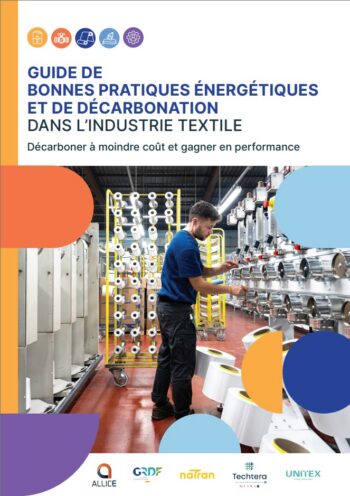
With the long-term rise in energy prices, decarbonization has become a key strategic issue for the textile industry. Beyond environmental concerns, it also offers real opportunities to reduce production costs, improve competitiveness, and meet growing customer expectations in terms of sustainability.
Producing in a more energy-efficient and controlled way is therefore a key lever to reduce dependence on fossil fuels and strengthen the sector’s long-term resilience.
Improvements without heavy investment
While some energy transition innovations require significant investment, many improvements can be achieved quickly and at low cost through simple actions such as:
- Optimizing equipment settings
- Improving process organization
- Managing equipment more efficiently
A guide to support action
A best practices guide has been developed by key stakeholders in the textile sector (including Unitex, Techtera, and ALLICE, with GRDF and NaTran), as part of an initiative supported by the Auvergne-Rhône-Alpes Region.
It includes 18 practical action sheets, structured around three main areas:
- Optimization of energy systems and networks
- Improvement of industrial processes (drying, dyeing, etc.)
- Energy management at site level
Decarbonization thus offers a practical and cost-effective way for the textile industry to improve efficiency while strengthening sustainability and competitiveness.
Contact: Juliette JAUPITRE – jjaupitre@techtera.org
Funders



Our certifications