
The recent major fire in Switzerland highlighted the crucial importance of using fire-resistant materials in construction materials, insulation, and many everyday objects.
Bio-based fibres represent a promising alternative to synthetic fibres derived from fossil resources; thus, contributing to the reduction of greenhouse gas emissions and the development of the circular economy. However, to gain access to large-scale textile applications, especially the construction, protective clothing and furniture industries, these fibres must meet strict fire resistance requirements.
Traditionally, the fire-resistant properties of synthetic fibres rely on the addition of inorganic, brominated, or organophosphate compounds. The organophosphate compounds are preferred because of their lesser impact on the environment. Their effectiveness is based on the formation of a protective charred layer and the limitation of the spread of flames and toxic gases. Nevertheless, these solutions must be adapted to bio-based fibres, whose development is progressing but remains hampered by the lack of durable and compatible flame retardants.
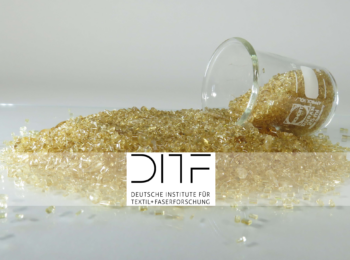
In this context, the DITF is developing Polyethylene Furanoate (PEF), a bio-based polymer with properties similar to PET, but which still lacks sufficient fire resistance for textile applications. The research focused on the covalent integration of phosphorus-based flame retardants directly into the polymer structure. This is done to prevent their migration and ensure long-lasting protection; at the same time, limiting the concentrations used.
The researchers also improved the molar mass of the polymers through solid-phase polymerisation, enabling the spinning of stronger fibres. The resulting fibres and textiles demonstrated significantly reduced flammability in fire tests. These results pave the way for a wider deployment of flame-retardant bio-based textiles on the market.
Website: https://www.ditf.de/
Funders





Our certifications